Adobe Stock/yordanka
There are many mysteries in life.
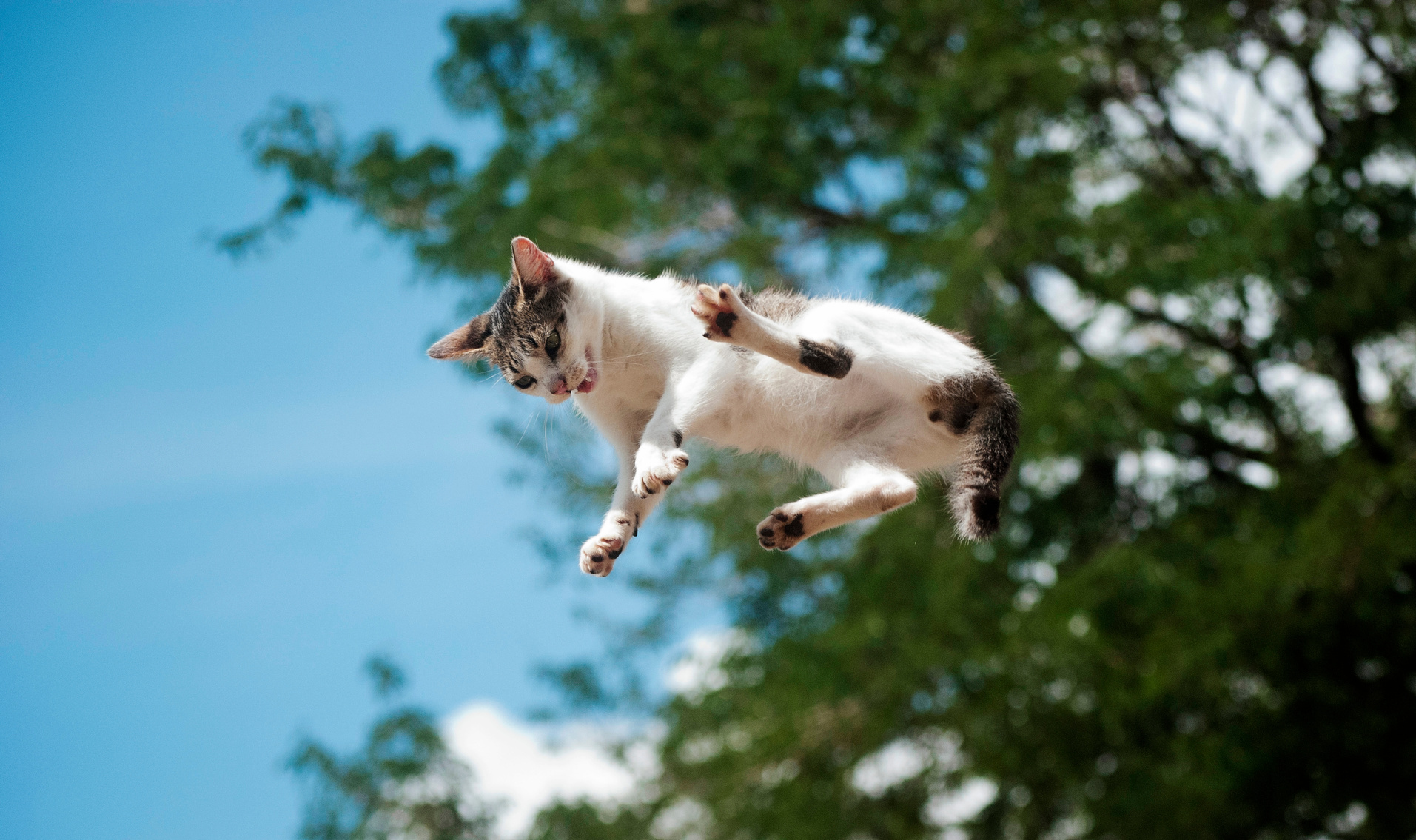
Why the printer jams only when you’re in a hurry. Why socks disappear in the dryer. And how cats can fall off a bookshelf, a refrigerator, or the back of a couch and somehow land like Olympic gymnasts sticking the vault.
For years, cat owners have simply shrugged and said, “Well… they’re cats.”
But now science has stepped in to confirm what every cat owner already suspected: cats are basically built like tiny, furry acrobats.
A new study from researchers at Japan’s Yamaguchi University has taken a closer look at feline anatomy and uncovered the mechanical secret behind the legendary cat landing. The answer, it turns out, lies in a very specific part of the cat’s spine.
And yes, it’s as impressive as it sounds.
The Secret Is in the Spine
Researchers discovered that the middle portion of a cat’s spine — called the thoracic region — is significantly more flexible than the lower part of the back.
That flexibility allows cats to twist their bodies midair in ways that most animals simply cannot.
When a cat begins to fall, its body can rotate in sections. The front half turns first, followed by the back half, allowing the animal to flip itself around and face the ground before impact.
Imagine doing a full body twist while falling off a ladder.
Now imagine doing it in less than a second.
That’s the cat version.
The Famous “Righting Reflex”
Scientists call this ability the “righting reflex,” which sounds very technical but basically means this: cats have an instinctive ability to figure out which way is down.
When a cat senses it’s falling, the head turns first toward the ground. The rest of the body follows, twisting through the flexible spine while the legs stretch out to prepare for landing.
All of this happens incredibly fast — often in just fractions of a second.
So the next time your cat rolls off the windowsill and lands like it planned the whole thing, it didn’t exactly plan it.
But its body absolutely knew what to do.
Nature’s Built-In Acrobat
Cats also have a few other advantages working in their favor.
They’re lightweight.
They’re extremely agile.
And they have lightning-fast reflexes.
Put all that together with a spine that bends like a yoga instructor on espresso, and you get one of nature’s most impressive little survival tricks.
Scientists have been fascinated by this ability for decades, but the new research adds another piece to the puzzle by showing just how important the flexibility of the thoracic spine really is.
Of course, veterinarians still caution that falls can be dangerous — especially indoors where floors are hard and unforgiving.
So while cats are impressive, they are not invincible.
The Lesson Humans Might Borrow
Now here’s where this story gets interesting.
Cats don’t panic when they fall.
They adjust.
They twist.
They adapt midair and do the best they can with the situation before they hit the ground.
There might be a life lesson hiding in there somewhere.
Because let’s be honest — life has a funny habit of knocking people off balance. Careers change. Plans collapse. The unexpected happens.
And in those moments, maybe the best thing we can do is take a page from the feline playbook.
Stay flexible.
Adjust quickly.
And try to land on your feet.
Cats, it seems, have been demonstrating that strategy all along.
RECENT

A Century of Appalachian Music Lives On
Entertainment

America’s Other Midnight Rider
Legends of the American Spirit

Michigan Speaker Pushes Drug Crackdown
In The States

Arizona Tightens Sex Offender Rules
In The States

It’s Never Too Late
Did You Know?

Meet Taylor Mieszkuc: A Rising Voice with “Matches”
Entertainment

Kentucky Acts on School Violence
Education

Breathe Your Way Back to Control
Friday Fuel

Where America Is Headed This Weekend
Happiness

Pennsylvania Veterans Expo Honors America 250
In The States
BE THE FIRST TO KNOW
Want to stay in the loop? Be the first to know! Sign up for our newsletter and get the latest stories, updates, and insider news delivered straight to your inbox.

More Content By
Georgia Dale
The Alligator Was Not the Problem (Actually, It Was)
Bless Your Headlines

HOA Money, Spa Day Edition
Bless Your Headlines
Kangaroo Chaos, Wisconsin Edition
Bless Your Headlines

The Most Honest Holiday Lineup
Uncategorized
Stroller Standoff Goes Viral
Bless Your Headlines

The Mayo Experiment
Bless Your Headlines

Crayons, Carbs, and Catastrophic Data Loss (Avoided)
Uncategorized
Florida Man Risks It All… for a Sunroof
Bless Your Headlines
The Wildest Headline This Week
Bless Your Headlines
Epstein Lookalike Frenzy
Bless Your Headlines
View All Content By Georgia Dale